
What Type of Ink Is Used in Pad Printing?
After more than ten years working as a pad printing and screen printing machine engineer, I can confidently say one thing:
Most pad printing problems are not caused by machines — they are caused by wrong ink decisions.
When buyers ask, “What type of ink is used in pad printing?”, they often expect a simple answer:
Solvent-based ink
One-component or two-component ink
But in real production, ink selection is never that simple.
Ink in pad printing is a system decision, tightly linked to:
Substrate material
Product geometry
Production volume
Environmental conditions
Machine configuration
Operator skill level
More importantly, ink choice directly affects equipment customization and procurement strategy.
This is something only people who have spent years inside factories truly understand.
This article explains pad printing inks from a real engineer’s perspective, not from brochures.
Table of Contents
Why Ink Plays a Bigger Role in Pad Printing Than in Other Printing Methods
Pad printing is unique because it relies on three material interfaces:
Ink ↔ steel cliché
Ink ↔ silicone pad
Ink ↔ product surface
If any one of these interfaces fails, printing fails — even if the machine itself is perfect.
That is why experienced engineers never talk about ink alone.
We always talk about “ink + pad + plate + machine + environment” as one system.
The Core Ink Types Used in Pad Printing
From real production lines, pad printing inks generally fall into four practical categories.
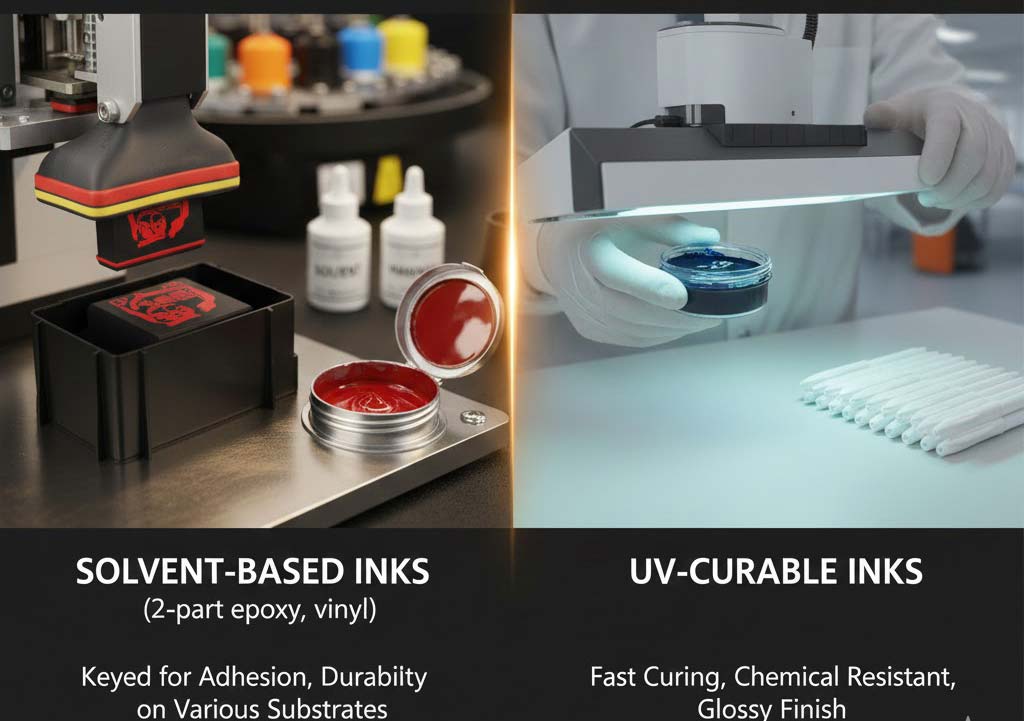
1. Solvent-Based Pad Printing Inks (The Industry Backbone)
Why Solvent-Based Inks Dominate Pad Printing
More than 80% of industrial pad printing applications still use solvent-based inks.
The reason is simple:
They transfer cleanly
They release well from silicone pads
They bond reliably with plastics and metals
From an engineering standpoint, solvent-based inks offer the widest tolerance window.
They forgive:
Minor humidity changes
Small temperature fluctuations
Operator inconsistencies
This forgiveness is critical in mass production.
Typical Applications
ABS, PC, PVC, PS plastic parts
Painted or coated metal surfaces
Consumer electronics housings
Automotive interior components
If your product uses injection-molded plastics, solvent-based ink is almost always the starting point.
One-Component vs Two-Component Inks
One-Component (1K) Inks
Air-drying
Easier to use
Shorter setup time
Best for:
Short production runs
Promotional products
Non-critical adhesion requirements
Two-Component (2K) Inks
Mixed with hardener
Chemical curing
Much stronger adhesion
Best for:
Automotive parts
Medical devices
Products requiring abrasion or chemical resistance
Procurement reality:
Factories that underestimate ink curing requirements often blame the machine later.
2. UV-Curable Pad Printing Inks (Growing but Not Universal)
UV pad printing inks exist, but they are far less forgiving than many buyers expect.
Advantages
Instant curing
Cleaner production environment
No solvent evaporation
Engineering Challenges
Requires precise UV energy control
Sensitive to surface energy
Pad contamination issues are common
From my experience, UV inks only work well when:
Product geometry is simple
UV exposure is uniform
Operators are well trained
This is why UV pad printing systems must be custom-engineered, not bought off the shelf.
3. Silicone and Special-Surface Inks
Printing on silicone, rubber, or low-surface-energy materials is a different game entirely.
Key Challenges
Ink rejection
Poor wetting
Long-term adhesion failure
These inks often require:
Plasma or flame pretreatment
Special pad materials
Controlled ink viscosity
Important procurement note:
If a supplier claims “our standard machine prints silicone easily,” that is a red flag.
4. Food-Grade and Medical-Grade Inks
In regulated industries, ink selection is not just technical — it is legal.
Requirements Often Include
Low migration
Biocompatibility
Sterilization resistance
Traceability documentation
From an engineer’s perspective, these inks:
Narrow the process window
Increase validation workload
Require more stable machine platforms
This directly affects machine price and customization level.
Ink Properties That Matter More Than Ink Type
Experienced engineers never ask only “What ink?”
We ask “What properties?”
1. Viscosity Stability
Ink viscosity changes with:
Temperature
Solvent evaporation
Cycle speed
Machines designed for long-run production often need:
Ink cup systems
Temperature-controlled ink trays
Automated solvent dosing
This is why high-end pad printing machines cost more — not because of steel, but because of process control.
2. Drying Speed vs Transfer Efficiency
Ink that dries too fast:
Sticks to the cliché
Does not release from the pad
Ink that dries too slowly:
Smears on the product
Extends cycle time
Balancing this is an engineering problem, not a purchasing checkbox.
3. Adhesion vs Elastic Recovery
Strong adhesion often conflicts with good pad release.
This is where:
Pad hardness selection
Pad shape design
Ink formulation
must work together.
How Ink Choice Directly Impacts Machine Customization
1. Ink System Design
Different inks require different systems:
Open ink wells
Sealed ink cups
Agitation mechanisms
A buyer choosing ink first after buying the machine often ends up retrofitting later — at higher cost.
2. Pad Selection and Pad Geometry
Ink chemistry determines:
Pad hardness (Shore A)
Pad surface energy
Pad lifespan
A standard pad rarely works for:
High-viscosity inks
UV inks
Silicone inks
This is why custom pad development is part of serious machine procurement.
3. Environmental Control Requirements
Some inks demand:
Constant temperature
Controlled humidity
Cleanroom-level dust control
If these needs are ignored during procurement, production instability is guaranteed.
Real Procurement Habits I See After 10+ Years
What Experienced Buyers Ask First
“Have you tested this ink on our material?”
“What is the yield rate after 8 hours?”
“What fails first: pad, ink, or cliché?”
These are engineering questions, not sales questions.
What Inexperienced Buyers Ask First
“How many colors can it print?”
“Is this machine cheaper?”
These buyers often return six months later with problems.
Common Procurement Mistakes Related to Ink
Mistake 1: Assuming Ink Is Universal
No ink works on all materials.
If a supplier claims that, walk away.
Mistake 2: Ignoring Long-Term Ink Cost
Ink price per kilogram means nothing.
What matters is:
Ink consumption per 1,000 prints
Scrap rate
Rework cost
Mistake 3: Buying Machines Without Ink Testing
Any serious manufacturer should:
Test your ink
Test your material
Simulate your production cycle
Without this, the machine price is meaningless.
How Professional Manufacturers Approach Ink + Machine as a System
From the manufacturing side, responsible suppliers do the following:
Ask about ink before quoting
Design pad and fixture around ink behavior
Adjust machine timing based on ink drying curve
Provide ink parameter documentation
This is the difference between a machine seller and a solution provider.