
What Is the Difference Between Pad Printing and Digital Printing?
Why This Comparison Still Matters in Modern Manufacturing
In today’s manufacturing environment, printing is no longer just about adding a logo or a label. It is a functional process that directly affects product identification, regulatory compliance, brand perception, and even assembly efficiency.
As a printing machine manufacturing engineer with years of experience designing, assembling, and customizing pad printing machines and screen printing systems for global clients, I am frequently asked one fundamental question:
Table of Contents
“What is the real difference between pad printing and digital printing—and which one should I invest in?”
This question usually does not come from beginners. It comes from procurement managers, factory owners, and engineers who already understand printing at a basic level, but need clear, experience-backed guidance to make the right capital equipment decision.
This article does not attempt to promote one technology over the other. Instead, it explains how each technology works, where it performs best, where it fails, and—most importantly—how buyers should evaluate customized printing equipment from a procurement perspective.
Understanding Pad Printing from an Engineering Perspective
How Pad Printing Works (Beyond the Textbook Definition)
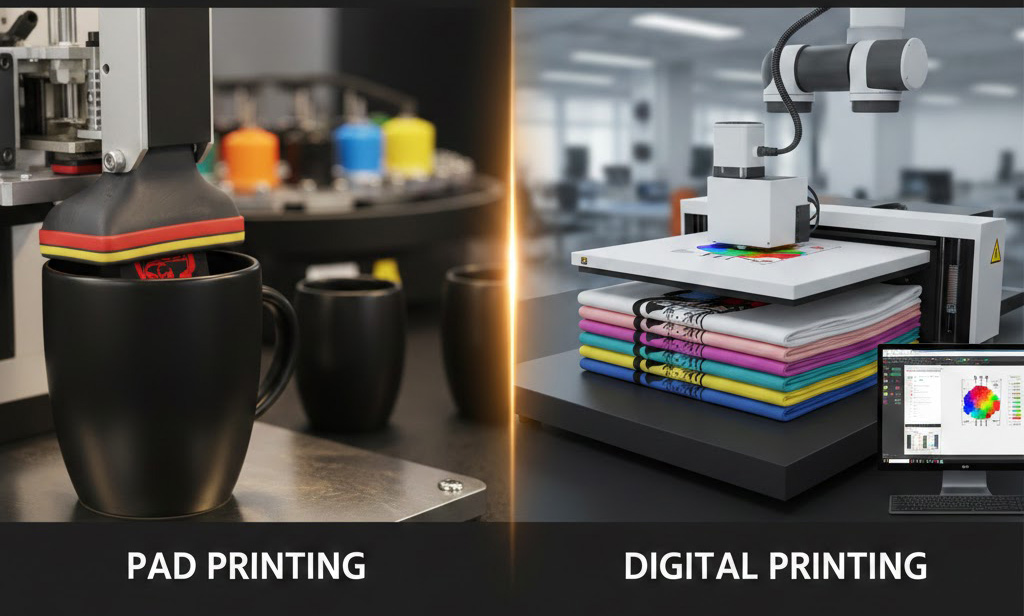
Pad printing is an indirect gravure printing process. Ink is transferred from an etched printing plate (cliché) to a silicone rubber pad, and then from the pad onto the substrate.
From a machine design standpoint, a pad printing system consists of:
Ink cup or open ink well system
Steel or polymer cliché
Doctoring mechanism
Silicone transfer pad
Precision X/Y/Z motion control
Substrate fixture or jig
What makes pad printing unique—and mechanically complex—is the elastic deformation of the silicone pad. The pad must compress, deform, and recover precisely within milliseconds, cycle after cycle, without distortion.
This is not trivial engineering.
Why Pad Printing Excels at Complex Shapes
From real production experience, pad printing is unmatched when dealing with:
Curved surfaces
Concave or convex geometries
Textured or uneven parts
Small-format, high-detail graphics
Typical products include:
Cosmetic containers
Medical devices
Automotive buttons and switches
Electronic housings
Promotional items
Digital printing systems, regardless of ink technology, struggle mechanically with these shapes because they rely on fixed print heads and controlled ink deposition distances.
Understanding Digital Printing in Industrial Applications
What Digital Printing Really Means in Manufacturing
In industrial contexts, digital printing usually refers to non-contact inkjet-based systems, including:
UV inkjet printing
Solvent inkjet printing
Water-based inkjet systems
Unlike pad printing, there is no physical printing plate. The image is generated digitally and printed directly onto the substrate via controlled ink droplets.
From an engineering standpoint, digital printing machines rely heavily on:
Printhead resolution and stability
Ink chemistry and curing systems
Software RIP systems
Surface pretreatment (plasma or flame)
Where Digital Printing Performs Best
Digital printing is highly effective when:
Designs change frequently
Short production runs are required
Full-color gradients or photographic images are needed
Flat or slightly curved surfaces are used
Common applications include:
Packaging prototypes
Short-run branding
Personalized products
Flat panels and labels
Core Technical Differences Between Pad Printing and Digital Printing
1. Contact vs Non-Contact Printing
Pad printing is a contact process. The silicone pad physically touches the substrate. This allows ink to be deposited into micro-textures, ensuring strong adhesion even on low-energy plastics.
Digital printing is non-contact, which reduces mechanical wear but introduces sensitivity to:
Surface energy
Ink spreading
Environmental dust and static
From an engineer’s view, contact printing offers mechanical forgiveness, while non-contact printing requires perfect process control.
2. Ink Transfer Mechanics and Adhesion
Pad printing inks are typically solvent-based and formulated to:
Transfer cleanly from steel cliché
Release from silicone
Chemically bond with plastic, metal, or coated surfaces
Digital inks, especially UV inks, rely more on surface curing than penetration. This means adhesion often depends on:
Surface pretreatment
Ink curing energy
Material compatibility
In high-reliability industries (medical, automotive), pad printing still dominates because adhesion consistency is easier to validate and control.
3. Production Speed and Stability
Contrary to popular belief, digital printing is not always faster.
Pad printing machines can reach 1,500–3,000 cycles per hour per station
Multi-color rotary pad systems can run continuously for mass production
Digital printing speeds are often limited by:
Print resolution
Ink curing time
Head maintenance cycles
For long-term, high-volume production, pad printing offers better cost stability.
Procurement Reality: How Buyers Actually Choose Printing Equipment
From my experience working with buyers across Europe, the US, and Southeast Asia, procurement decisions are rarely based on technology alone.
What Buyers Care About (Beyond Marketing Claims)
When evaluating pad printing or digital printing equipment, buyers focus on:
Application compatibility
Long-term operating cost
Machine stability and repeatability
Ease of maintenance
Customization capability of the manufacturer
This is where many suppliers fail.
Customized Printing Equipment: Why Standard Machines Often Fail
The Myth of “One-Size-Fits-All” Printing Machines
In real factories, products are rarely uniform. They vary in:
Shape
Material
Tolerance
Orientation
Throughput requirement
As a machine manufacturer, we know that standard catalog machines often lead to:
Poor registration accuracy
Low yield rates
Frequent operator intervention
This is why experienced buyers increasingly demand customized pad printing or screen printing systems.
Key Customization Areas Buyers Should Evaluate
1. Fixture and Jig Design
Fixtures are often overlooked, yet they determine:
Print position accuracy
Cycle time
Operator ergonomics
A well-designed jig can improve yield by 10–20% without changing the printing method.
2. Automation and Integration Capability
Modern procurement increasingly considers:
Robotic loading/unloading
Vision inspection integration
Conveyor synchronization
MES or ERP data connection
Pad printing machines are easier to integrate mechanically due to their modular structure.
3. Ink System Customization
Buyers should assess whether the manufacturer can support:
Ink cup vs open ink system selection
Multi-color ink management
Environmental control (temperature, humidity)
This is especially critical for export-oriented factories where process consistency matters.
Cost Comparison: CAPEX vs OPEX
Initial Investment (CAPEX)
Pad printing machines: generally lower entry cost
Digital printing systems: higher upfront cost due to printheads and electronics
Operating Cost (OPEX)
Pad printing costs include:
Cliché production
Ink consumption
Pad replacement
Digital printing costs include:
Printhead replacement
Ink cost per unit
Maintenance downtime
Over a 3–5 year lifecycle, pad printing often proves more economical for stable, repeat production.
Reliability, Validation, and Compliance
In regulated industries, buyers must validate:
Ink adhesion
Abrasion resistance
Chemical resistance
Print durability
Pad printing has decades of validated industrial data, which simplifies compliance documentation.
Digital printing is improving rapidly, but validation is often application-specific and less standardized.
When Should Buyers Choose Pad Printing?
Choose pad printing when:
Printing on complex shapes
Long production runs
High adhesion reliability is required
Multi-shift mass production is planned
When Digital Printing Makes More Sense
Choose digital printing when:
Designs change frequently
Customization or personalization is needed
Short production runs dominate
Flat substrates are used
The Manufacturer’s Responsibility: More Than Selling a Machine
From an engineering standpoint, a responsible printing machine manufacturer should provide:
Application testing before sale
Transparent limitation disclosure
Custom fixture and automation design
Long-term technical support
Buyers should avoid suppliers who only sell machines, not solutions.
Final Thoughts: Technology Is a Tool, Not a Decision
The difference between pad printing and digital printing is not about which is “better.” It is about which technology aligns with your product, production strategy, and procurement reality.
From my experience as a printing machine manufacturing engineer, the most successful buyers are those who:
Understand their real application needs
Evaluate customization capability seriously
Think in lifecycle cost, not unit price
Choose manufacturers, not traders
In modern manufacturing, the right printing technology is the one that disappears into the process—reliable, stable, and unnoticed.